


News
Making progress but hard yards ahead
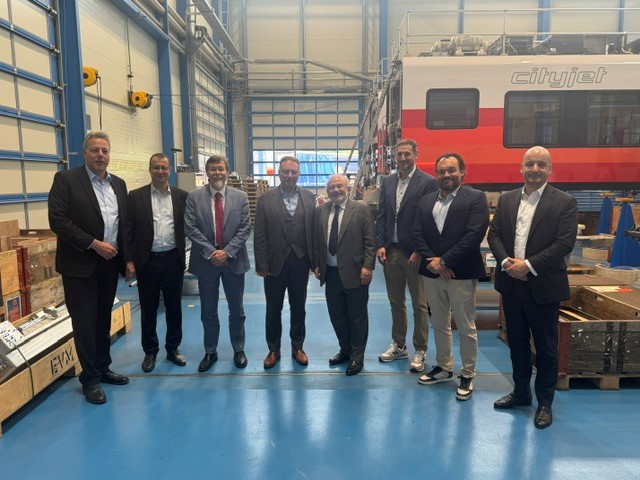
The 19th Annual General Meeting took place on 19th May at the Stadler head office in Bussnang, in eastern Switzerland. Members attending in person were given a detailed presentation about Stadler including a personal guided tour around the factories. “The Stadler facility is hugely impressive” said RWG chair Howard Rosen “and for those of us not involved day-to-day in the manufacturing process for rolling stock, it is also tremendously helpful to get back to the practical realities”, he continued.
With more than 40 members represented in person or online, a record attendance, the AGM welcomed the position paper issued jointly by Helvetia and the RWG on how the Luxembourg Rail Protocol can mitigate risks for insurers. It also re-elected Chris Forster as Treasurer of the Association and set new subscriptions for 2027, continuing the process of putting the Association on a sound financial footing.
At the Meeting, members reviewed the current position with the adoption of the Luxembourg Rail Protocol. In particular members welcomed the inclusion of the accession to the Protocol in the UK rail legislation currently going through British Parliament and the moves towards accession in certain African states and in the GCC area. But, commented Mr Rosen, it was slow and the Association continues to explore different ways to communicate to both governments and the rail industry how the Protocol can only deliver economic, social and environmental benefits, supporting the rail industry. In particular, the RWG chair called on OECD export credit agencies to follow the lead of ECIC in South Africa and to provide a “Cape Town discount” on risk premiums when the Cape Town Convention was applied to rolling stock by the Protocol, in the same way as they discount their risk premiums for aircraft. Progress was being made, concluded Mr Rosen, but there remains hard yards ahead.
NOTES FOR EDITORS
The Luxembourg Rail Protocol to the Cape Town Convention on International Interests in Mobile Equipment is a new global treaty under the auspices of UNIDROIT, the International Institute for the Unification of Private Law. The Protocol will make it much easier and cheaper for the private sector to finance all types of railway rolling stock. It sets up a new system for recognition, priorities and enforcement of creditor and lessor rights, which will be registered in an international registry based in Luxembourg, accessible to everyone over the internet 24/7 and introduces, for the first time a new global unique permanent identification system (URVIS) for rolling stock. The United Nations has adopted global Model Rules on the Permanent Identification of Railway Rolling Stock setting out minimum standards for the permanent marking of railway rolling stock with URVIS numbers. The upgrading of the Model Rules to include digital platforms will create significant additional benefits for the industry. The Protocol entered into force in contracting states on 8th March 2024.
The European Union (in respect of its competences). Gabon, Luxembourg, Paraguay, South Africa, Spain, and Sweden have ratified the Protocol. France, Germany, Switzerland, Mozambique, Italy, and the UK have already signed the Protocol but have not yet acceded to the Protocol. Many other states, including Saudi Arabia, the Democratic Republic of Congo, Kenya, Malta, Eswatini, Namibia, Zimbabwe, Ethiopia and Mauritius, are actively looking at ratification of the Protocol. The Protocol is endorsed by many international rail organisations (including the African Rail Industry Association, OTIF, CIT, UIC, UIP, ERFA, ALLRAIL, UITP, CER and Eurofima) and actively supported by the African Union, the UN Economic Commission for Africa and the UN Economic Commission for Europe.
The Rail Working Group is a Swiss-based not-for-profit association focused on the adoption and implementation of the Luxembourg Rail Protocol. It has about 90 direct members and hundreds of additional rail stakeholders represented indirectly by various industry organisations that belong to, and support the objectives of, the RWG.
For more on the Luxembourg Rail Protocol and the Rail Working Group visit www.railworkinggroup.org.
Further information from the Rail Working Group:
Tel. +41 41 760 28 88
WhatsApp: +41 79 340 21 53
Email LinkedIn Africa Contact Europe Contact
ENDS


